

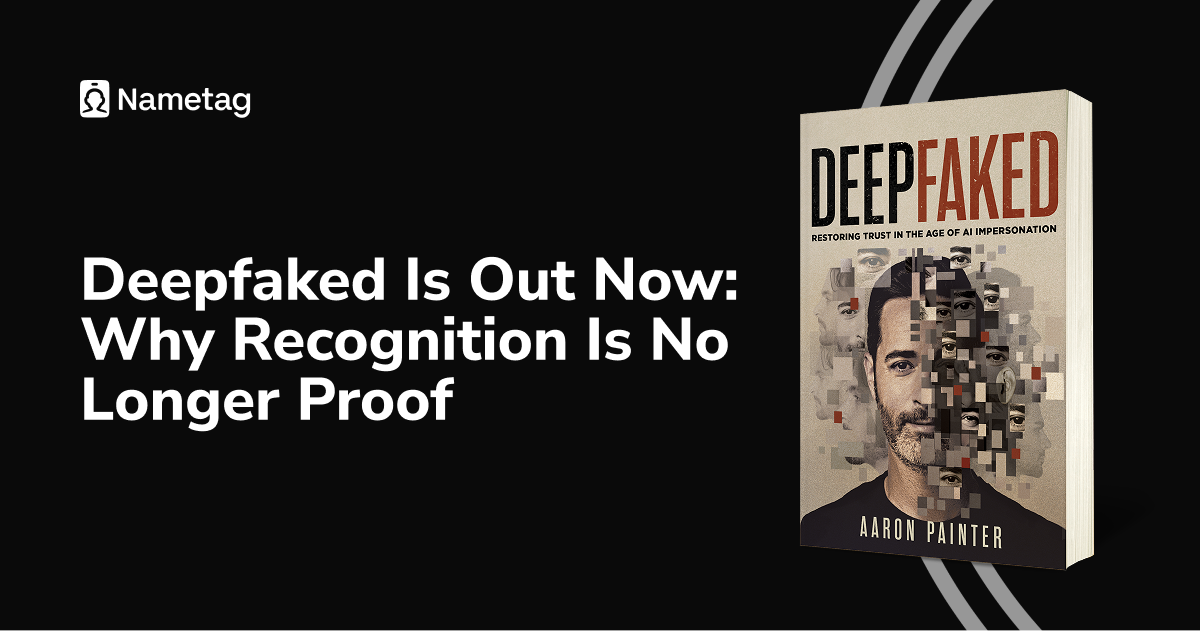

Recognition is no longer proof of identity, because AI can now copy a face, a voice, and a writing style well enough to pass at a glance. That’s the argument of Deepfaked: Restoring Trust in the Age of AI Impersonation, the new book from Nametag CEO Aaron Painter, published by Fast Company Press on October 13, 2026. Instead of trying to spot fakes, the book argues, organizations need a better way to prove identity.
Deepfaked is available now on Amazon, where it’s an Amazon Best Seller.
It started with a phone call
A few years ago, someone used an AI voice clone of Aaron to call his grandma. The caller said Aaron was in trouble and needed money wired immediately.
She almost believed it. The voice was her grandson's voice, and the story was urgent and believable. What stopped her was one small detail: the caller didn't use the nickname the family always used for Aaron's grandfather. A nickname saved her.
That call is the reason Aaron started Nametag, and the reason he wrote Deepfaked. The book is dedicated to her.
The same call, at work
Swap grandma for a helpdesk agent, a finance manager, or a hiring team, and the call is the same. Every organization has a grandma: a well-intentioned person who trusted a process that was built for a world where recognition was enough. They aren’t careless, the process is out of date.
A voice asks for a password reset. An executive appears on a video call and approves a wire. A candidate interviews well and turns out never to have been who they claimed.
At the engineering firm Arup, a single deepfaked video meeting led to $25.6 million in wire transfers. And it isn’t rare: a Gartner survey found that 62% of organizations experienced a deepfake attack involving social engineering or automated processes in the prior 12 months, and Unit 42 found that social engineering was the top initial access vector in 36% of the incidents it investigated.
Verify the person, not the voice
Deepfaked is a playbook, not a warning. It argues that the answer to AI impersonation is not getting better at spotting fakes, because that race gets harder every month. The answer is to verify the real person, with proof of who they are, at the moments that matter: a password reset, a high-risk change, a new hire, an approval.
The book is just as concerned with the emotional impact of being defrauded. Verification should protect people without treating everyone like a suspect.
Those are the ideas we work on every day at Nametag, and they're why we're excited to share these stories.
What's inside
The book moves from the personal story to the practical, covering:
- Helpdesks as attack targets, and why a familiar voice is not a credential.
- Hackers who log in instead of breaking in.
- Hiring people you have never met in person.
- How to rebuild trust once faces and voices stop working as proof.
Readers from across security and enterprise software have already weighed in.
"In the age of AI and deepfakes, we need better ways to know who we're actually interacting with. This book shows how identity and verification will need to evolve so we can capture AI's benefits without undermining trust in each other." Bill Gates
"Defending real people at scale taught me that recognition isn't security; proof is. Painter captures that shift exactly, and lays out the layered, practical defenses that actually hold up against AI. This is the playbook I wish every security team had five years ago." Latha Maripuri, former CISO, Uber; CISO, Nscale
Get your copy
Deepfaked: Restoring Trust in the Age of AI Impersonation is available now from Amazon. If you lead security, IT, finance, or hiring, it is written for you, and it makes a good read to share with your team.
You can find more about the book, the press kit, and Aaron's recent interviews at aaronpainter.com, and subscribe to his new writing on Substack.
Thank you to everyone who helped bring this book to life, and to the grandma who started it all.


