

TLDR
- Manufacturers verify contractor identity by confirming the person, not just the record, before access is granted.
- Agency background checks, identity providers, and badges all confirm records, and none confirms the human. Unverified identity costs a 15,000-employee manufacturer about $6.54M a year, roughly $126,000 a week.
- Verification takes as little as 20 seconds on the contractor's own phone, and credentials issue only after a pass.
A stopped line doesn't stop alone
In late August 2025, Jaguar Land Rover shut down its systems after a cyberattack. Production at its three UK factories, which together build about 1,000 cars a day, stopped for more than a month. The Cyber Monitoring Centre, an independent nonprofit, estimated the cost to the UK economy at £1.9 billion and said most of it came from lost output at JLR and its suppliers. More than 5,000 organizations were affected, from multi-tier suppliers to downstream dealerships.
Whatever the entry point, a shutdown reaches the line through connected systems, and workforce identities are how people reach those systems. That raises a plain question about who those people are.
Who actually has access to the plant?
Not only employees; contractors service the lines, staffing agencies fill third shift, third-party engineers connect to equipment from another time zone. Employees, contractors, engineers, and shift workers all sign in through the same system, and yet each group is governed differently.
Every one of them needs access quickly, and waiting is expensive. Siemens' 2024 True Cost of Downtime report puts an hour of unplanned downtime at a large automotive plant at $2.3M, about double what it cost in 2019.
So access gets granted fast. An agency sends a name and an email. IT issues a credential. A badge prints at the gate. Nobody in that chain did anything wrong. It's the process most plants built with the tools they had.
What does each step actually confirm?
The agency confirms that a background check came back clear. The identity provider, the system that issues and checks logins, confirms that the credential is valid. The badge confirms that someone checked in at the gate. All three confirm a record. None of them confirms that the person at the gate, or logging in over the VPN, is the person in the record.
For almost every contractor, that doesn't matter. The process works because most people are who they say they are. It also passes a borrowed identity through the same steps, because nothing in it was built to notice.
Why does that matter more now?
It has already happened at scale. In one federal case, the Justice Department said North Korean IT workers landed jobs at 309 US companies, including an aerospace manufacturer and an American car maker, using the stolen identities of 68 real US residents, according to The Register's report on the case. The identities belonged to real people. The people presenting them did not.
Two changes make that easier to repeat. AI has made a convincing voice, a forged document, and a synthetic video, which is a clip generated or altered by AI, cheap to produce. And plant systems that used to be isolated now connect, so a login can reach production equipment it never could before.
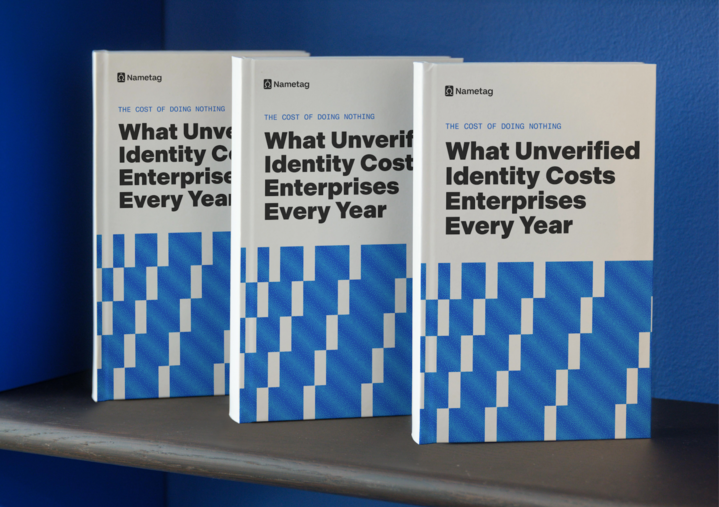
The exposure carries a price. IBM's 2025 Cost of a Data Breach Report puts the average manufacturing breach at $5.0M, and in a plant a breach doesn't only expose data. It stops production. Nametag's research, What Unverified Identity Costs Enterprises Every Year, totals the cost of leaving identity unverified. For a manufacturer with 15,000 employees, it comes to about $6.54M a year, roughly $126,000 a week, across workforce productivity, annual loss expectancy, operational efficiency, and hiring fraud. No budget has a line for it, which is why it's easy to miss.
What do most plants rely on today?
Most plants rely on tools built to authenticate. Authentication proves which account is acting. Verification proves which human is acting. Identity providers like Okta and Microsoft Entra ID handle the first job well, and they stay the foundation. Nametag completes them with the second.
How does identity verification support zero-trust access for new workers?
Identity verification supports zero-trust access for new workers by confirming the person before any credential is issued, so access starts from a verified human. Zero trust means verifying every access request instead of trusting a network location or a badge. Verification applies that idea at the first moment of access, which is the moment most plants skip.
Nametag is a workforce identity assurance platform that verifies the real human behind high-risk actions, and issuing a contractor's credential is one of them. The Onboard module sends the contractor a link or QR code. The contractor scans a government-issued ID and takes a live selfie on their phone, with no app to download. The initial full verification takes as little as 20 seconds.
Nametag returns a clear pass or fail decision and binds the verified identity to the contractor's record in Entra ID, Okta, or another directory. Credentials issue only after a pass. Contractors retrieve their own through a self-service flow, so IT isn't sending them over email or phone. Nametag verifies again before device enrollment and system access provisioning.
Direct, agency, and contract workers verify the same way. Contractors who return to the plant verify again with just a selfie in as little as 3 seconds, so the second visit is faster than the first.
What changes when contractors verify first?
- Day-one access ties to a verified person instead of an email address.
- IT headcount stays flat as the contractor workforce scales, because self-service absorbs the credential reset volume.
- The agency still does its job, and production still starts on time.
- When an auditor asks who had access to a line controller in March, the plant has an answer.
Three questions worth asking this week.
- Who verifies a contractor's identity before a credential is issued?
- What confirms that the person on a vendor support call is the vendor's engineer?
- How would your team prove who had access after an incident?


